

Slip Ratings for Decking: What They Are & Why They Matter


Quick Summary – TLDR
Slip resistance is the formal term used under AS 4586, though people often call it a slip rating. In Australia, both P ratings and R ratings are recognised under Australian standard. However, P ratings are more commonly used for National Construction Code (NCC) 2025 compliance.
Table of Contents
What is slip resistance?
Slip resistance is the formal Australian term for how much grip a surface provides underfoot, particularly when it’s wet. You’ll often see it called “slip ratings” in everyday conversation, but if you’re dealing with a builder, certifier or product spec sheet, you’ll see “slip resistance” as the official language.
The governing document is AS 4586, an Australian Standard that sets out how surfaces are tested and classified. Products that meet the NCC’s 2025 requirements will reference this standard.
Slip resistance isn’t just a nice-to-have. It’s a compliance requirement for outdoor decks, ramps, stairs and various other surfaces. Getting it wrong creates both a safety hazard and a liability issue.
P ratings vs R ratings: what’s the difference?
This is where a lot of people get confused and understandably so. P ratings and R ratings are two entirely different testing methods and they measure different things.
P ratings (Wet Pendulum Test)
The P rating comes from the wet pendulum test. A pendulum device is placed on the surface, water is applied and the pendulum is swung across it. The more grip the surface has, the less the pendulum swings back up. The result is a P classification from P0 (very low slip resistance) through to P5 (high slip resistance). This is the most referenced slip classification method.
| Rating | Slip resistance level | Typical Application |
|---|---|---|
| P0 – P1 | Very low | Dry internal areas only |
| P2 | Low | Low-traffic internal areas |
| P3 | Moderate | General internal commercial use |
| P4 | Good | Wet areas, exterior exposed to weather |
| P5 | High | Ramps, pool surrounds, high-risk wet areas |
R ratings (Oil Wet Ramp Test)
The R rating comes from the oil wet ramp test, which is a European-origin testing method. Testers physically walk up an oil-covered ramp at increasing angles until they slip. The angle at which slipping occurs determines the R rating.
The R scale runs from R9 (lowest) to R13 (highest).
The key thing to understand: R ratings are not used to determine compliance with Australian building codes in the same way P ratings are. They can be referenced alongside a P rating and offer useful additional context, but a product with only an R rating has not necessarily been tested to the standard the NCC expects.
For example, a decking product might be marketed with an R11 rating but have no P rating at all. That means it hasn’t been tested using the wet pendulum method that the NCC primarily relies on. While it sounds compliant, an R rating may not be accepted by your certifier.
| Rating | Slip resistance level | Typical Application |
|---|---|---|
| R9 | Low | Dry internal areas |
| R10 | Moderate | Areas with occasional wetness |
| R11 | Good | Frequently wet external areas |
| R12 | High | Ramps, commercial wet areas |
| R13 | Very High | Industrial or extreme wet environments |
What deck slip rating should you look for?
For decking compliance, you’ll typically see both referenced. The NCC 2025 specifies either a P or R rating as acceptable minimums, so a product certified at P5 (Modwood Marina decking) or R11 (Modwood Xtreme Guard decking) both meet the same requirement for a standard outdoor deck.
If a composite decking product only has an R rating, it’s worth asking the supplier whether pendulum test results (P rating) are also available. If you’re specifying for a large-scale commercial project, a P rating is more useful because the ramp test is a laboratory method only.
What deck slip rating does the NCC require?
The National Construction Code sets out minimum deck slip rating requirements for outdoor surfaces. These requirements apply whether you’re building with timber or composite. The material doesn’t change the obligation.
- Standard outdoor deck (exposed to weather, likely to get wet): minimum P4 or R11
- Ramp steeper than 1:14: minimum P5 or R12
Disclaimer: some localities may require different minimums. Please confer with a local builder to confirm your areas specifications.
Is timber or composite decking better slip rated?
Composite decking is much more likely to have documented slip resistance ratings readily available.
Why composite slip ratings are easier to specify
Composite decking is a manufactured product. Every board off the same production run will behave consistently, so a single test result applies across the whole product range. Brands like Modwood and NewTechWood have had their products formally tested and publish the results.
Does timber decking have slip ratings?
Timber is more variable. Slip resistance depends on the species, the board profile (whether it’s grooved, reeded or smooth) and crucially, what finish has been applied. A rough-sawn or reeded board will generally perform better than a smooth, oiled one.
Because of this variability, formal slip resistance testing of timber decking is less common. Timber can and in many cases does meet slip requirements. But you’re less likely to get a certificate from a timber supplier than from a composite one.
What about indoor flooring slip ratings?
Slip resistance applies to internal flooring as well, under the same AS 4586 standard, but the requirements are quite different from outdoor decking.
Indoor floors are generally not expected to get wet the way a deck does, so the minimums are lower. A general internal commercial floor might only need to achieve P3. Wet areas like bathrooms and commercial kitchens have higher requirements, and stairs have their own specific classifications.
If you’re selecting flooring for a wet area, an entry lobby or a staircase, it’s worth understanding the slip resistance classification of what you’re buying. But the thresholds, testing context and application guidance for flooring are a separate conversation from decking and worth looking at specifically for the space you’re dealing with.
How to check slip ratings before buying
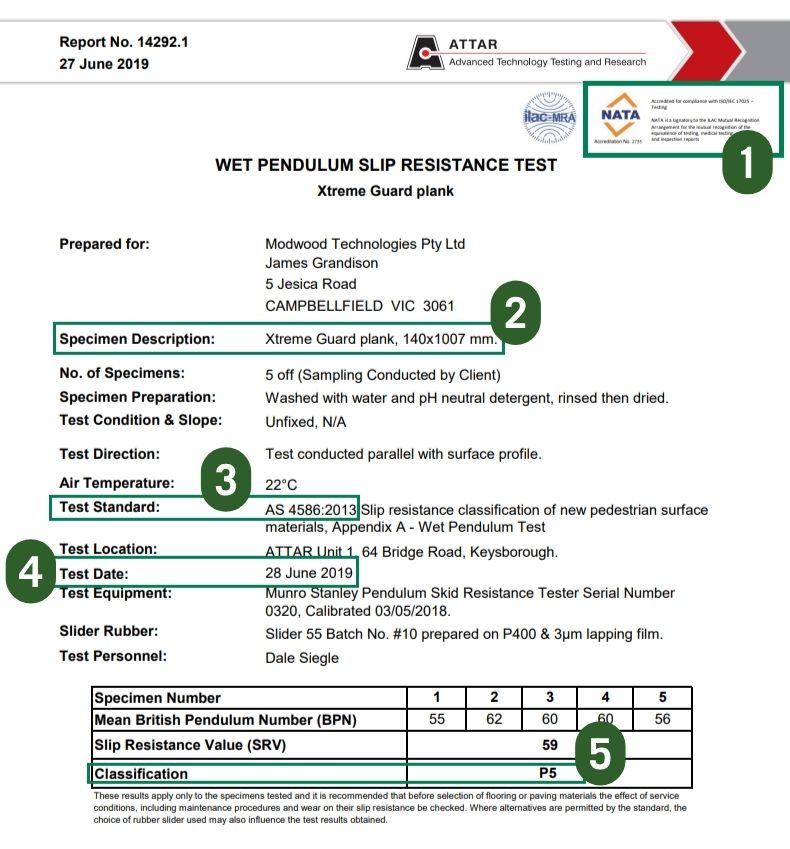
The simplest way is to ask for the slip resistance test certificate. This should reference AS 4586-2013 and include the P or R classification achieved.
A few things to check on the certificate:
- Is it P4 or R11 as a minimum (for a standard exposed outdoor deck)?
- Was the tested sample the same product and surface finish as what you’re buying?
- Is the test date reasonably recent and from an accredited testing body?
Below is an example of a Wet Pendulum Slip Resistance Test published by Modwood for their Xtreme Guard composite decking boards